tree-service
How Much Does Tree Removal Cost in Montana? A 2026 Price Guide
Tree removal cost in Montana for 2026: pricing by tree size, rural travel charges, beetle-killed timber, storm work rates, firewood credits, and stump grinding.
In This Article
- Where You Live Changes the Bill
- What Size Costs in Montana
- The Trees Montana Homeowners Take Down
- Standing Dead Timber and Beetle Damage
- A Seven Month Working Season
- Snow Load, Chinooks, and Ice
- Firewood, Chips, and What You Can Keep
- Checking Out a Contractor in a Small Market
- Montana Tree Removal Questions
How Much Does Tree Removal Cost in Montana? A 2026 Price Guide
In Bozeman or Missoula proper, a 50 foot tree in an open yard runs $700 to $1,400. Move that same tree 40 minutes out the valley on a gravel road and the quote climbs to $1,000 to $1,900, because the crew is spending two hours of the day driving.
That is the first thing to understand about tree work in Montana. Distance is a line item. Crews are concentrated in Billings, Missoula, Bozeman, Kalispell, Great Falls, and Helena, and everything outside those service areas carries a mobilization charge of $150 to $500.
The second thing is the calendar. Montana crews have roughly seven working months, and everyone wants the same July and August dates. Homeowners who call in June for August work often end up on a fall list instead.
Where You Live Changes the Bill
A property inside city limits with paved access and a wide driveway is the cheapest scenario in the state. Equipment gets close, disposal is a short haul, and the crew can fit two jobs into a day.
Rural properties change all three variables. A gravel approach that a loaded chip truck cannot climb in the rain, a gate 30 feet from the tree, or a septic field the crew cannot drive across all add hours.
Distance from a disposal site matters as much as distance from town. Some crews chip everything on site to avoid the haul, and that is worth agreeing to in advance if you have somewhere to put the chips.
Ask for the mobilization charge as a separate number on the estimate. Two companies quoting $1,400 and $1,650 may have identical removal prices with a $250 travel difference, which changes how you compare them.
What Size Costs in Montana
Small trees under 25 feet, including the ornamental crabapples and mountain ash common in older neighborhoods, run $300 to $600. Mid-size trees from 25 to 50 feet run $600 to $1,400.
Larger trees from 50 to 75 feet run $1,200 to $2,600. Mature cottonwoods and old ponderosa pine above 75 feet run $2,200 to $4,500, and more when the tree is over a structure.
Montana prices run below the national average for comparable work, mostly because labor and disposal cost less here. What closes the gap is travel and equipment scarcity.
Crane availability is limited outside the larger towns. When a crane has to come from another city, expect $1,000 to $2,500 added, and expect to schedule around the crane rather than the tree crew.
The Trees Montana Homeowners Take Down
Cottonwood is the most common large removal in the state. They grow fast along the Yellowstone, the Bitterroot, the Clark Fork, and every irrigation ditch, and they shed limbs without warning once mature.
The wood is heavy, wet, and low value, so disposal drives the cost. A 36 inch cottonwood can produce more volume than two ponderosa of the same height.
Ponderosa pine is the second common removal, particularly on properties where homes were built into existing stands around Missoula, Helena, and the Flathead. These are straight, workable trees and crews handle them efficiently.
Blue spruce planted as yard trees in the 1960s and 1970s have now outgrown their spots. Removing one 45 feet tall and three feet from a foundation runs $900 to $1,800 because every limb has to come off before the trunk can move.
Green ash and Siberian elm fill out older town neighborhoods in Billings and Great Falls. Both split at weak unions and both are frequent storm casualties.
Standing Dead Timber and Beetle Damage
Mountain pine beetle activity has left dead lodgepole and ponderosa across large parts of western Montana. Dead conifers near a house are removal candidates, and the pricing is not the same as green wood.
Dead standing timber is lighter, which helps, but it is unpredictable under load. Bark slips, tops break off during rigging, and climbers often refuse to work a tree that has been dead more than three or four years.
That pushes the job to a bucket truck or a crane, or to felling whole if there is room. Expect $200 to $800 above the price of a comparable live tree, and expect the crew to price conservatively.
Fire risk is the other reason to deal with it. Dead conifers within 30 feet of a structure are the fuel that turns a grass fire into a house fire, and clearing that zone costs far less than the alternative.
Broader fuel reduction work is priced by the hour or by the acre rather than per tree, generally $1,200 to $4,000 per acre depending on density and slope.
A Seven Month Working Season
Most Montana tree companies run hard from April through October. November through March they take emergency calls, do some pruning on mild days, and run smaller crews.
Winter removals do happen and can be a bargain. Frozen ground supports equipment without rutting a lawn, and quotes in January often come in 15 to 25 percent below July on the same tree.
The catch is access. A driveway with two feet of snow is not a work site, and a mountain property that loses road access in December is not getting a chipper truck up it.
Book non-urgent removals in the fall for late winter work if your access holds. That is the value window most homeowners here never use.
Snow Load, Chinooks, and Ice
Montana breaks trees three ways. Heavy wet snow in spring and fall loads leafed-out branches past their limit, chinook winds along the Rocky Mountain Front hit sustained speeds that snap weakened tops, and ice storms in the eastern half of the state coat everything.
Storm response is priced at 1.5 to 2 times standard rates, and in a small market you may wait days regardless of what you pay. Crews triage by danger, so a tree on a roof gets attention before a tree across a fence.
Preventive pruning is the counter. Removing deadwood and reducing end weight on a mature cottonwood at $400 to $1,000 is a fraction of what an emergency removal plus roof repair costs.
Look at your trees in November, not April. Deadwood is visible without leaves, and that is the walk-around that tells you what needs attention.
Firewood, Chips, and What You Can Keep
Montana is a firewood state, and that changes the economics. Larch, fir, and pine rounds left on site have real value, and many homeowners ask the crew to buck the trunk to 16 inch lengths and leave it.
Some companies will discount the job for the right wood. Clean larch or fir in workable lengths is worth keeping, and a crew that can resell it may knock $100 to $300 off the removal.
Cottonwood is the exception. It burns poorly, it is heavy to handle green, and nobody wants it, so expect to pay full disposal on it.
Chips are usually free for the asking. A load dumped on your property saves the crew a trip and gives you mulch for beds and paths.
Checking Out a Contractor in a Small Market
Montana does not license tree services the way some states license contractors, which puts more weight on verification. Ask for a certificate of general liability insurance and for proof of workers compensation coverage before anyone climbs.
An ISA certified arborist on the crew is the credential worth looking for. It signals training in rigging, tree biology, and hazard assessment rather than just chainsaw experience.
Get the scope in writing, including whether stump grinding, log removal, and chip cleanup are included. Those three items account for most of the disputes that come up after the fact.
Be careful with crews traveling through after a storm. A local address, local references, and a Montana phone number are the basic filters. Comparing established tree service companies near you before storm season means you are not making that judgment call under pressure.
Montana Tree Removal Questions
How much does stump grinding cost here?
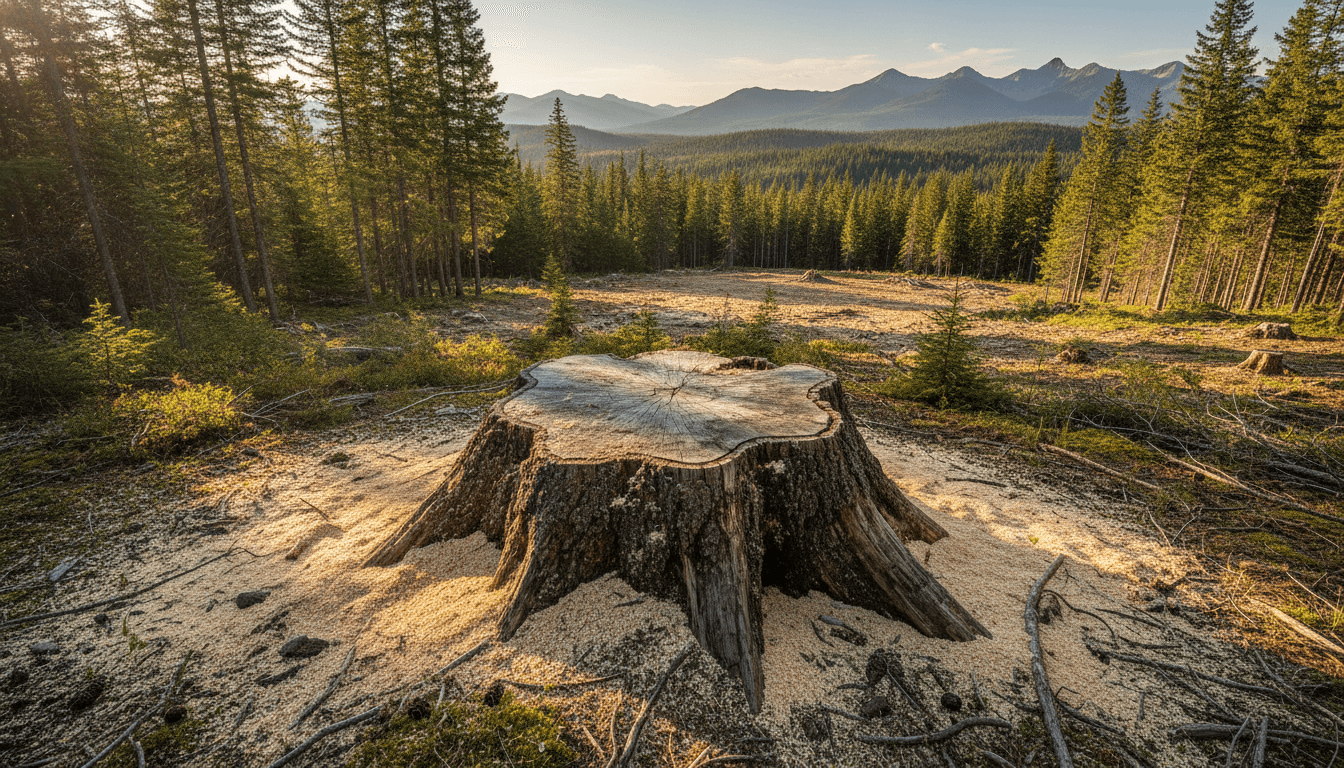
Between $3 and $6 per inch of stump diameter with a $125 minimum, so a 30 inch cottonwood stump runs $110 to $180. Rural properties often see a $75 to $150 equipment travel charge on top.
Can I take down a tree on my own property without a permit?
On private land in most of Montana, yes. Some cities regulate boulevard trees between the sidewalk and the street, and those belong to the municipality rather than to you.
Is it worth paying for an arborist assessment?
For a large tree near a house, yes. A $200 to $500 written assessment tells you whether you are looking at a removal, a pruning, or a tree that has years left, and it holds up if a neighbor disputes it.
What does emergency storm work cost?
Expect 1.5 to 2 times standard rates plus any after-hours premium. A tree on a roof at midnight in Kalispell can run $2,500 to $5,000 before any repair work begins.
Do crews work in the Bitterroot and Flathead valleys year round?
Larger companies do, weather permitting. Smaller outfits scale back from December through February and take mainly emergency calls, so plan non-urgent work around that.
Getting quotes with travel broken out, dealing with dead conifers before they go brittle, and using the winter window are the three moves that keep Montana tree costs in line. More Montana home service cost guides are on our home services blog.